Story Guide and Museum Content
The museum covers the following topics and you will find distinct areas dedicated to each one:
- Diagnosis Alley: how diseases spread in the past and the impact of the plague
- Autopsy: the origins and development of the study of human anatomy and pathology
- Theories: covering the four humours, religion, and misma
- Sexual Health: personal grooming, prophylactics, STIs, and human anatomy [Please note this area is separated from the main galleries by a door.]
- Breakthroughs: major moments in medical history
- Barber Surgery: the origins of surgery and early surgical practices
- Surgical Advances: improvements in surgical techniques and tools
- Housing and Hygiene: including both personal hygiene and public health
- Magical Medicine: looking at alchemy, witchcraft, and representations in popular culture
- Skeletal Science: what skeletal remains tell us about health and disease in the past
- Quack Medicine: a wide-variety of quacks, hoaxes, and con-artists throughout history
- Medicinal Plants: how plants have been used as treatments in medicine
- Food: covering food adulteration, preservation methods, nutritional needs, etc
- Pandemics: a visual installation on the impacts of major pandemics in history
In order to help prepare your school visit to Sick to Death, below is a photo tour of the museum layout, along with notes on the content covered in each section of the museum. If you have more questions, please get in touch and we will do our best to help you prepare for your visit.

St Michael’s Church, where Sick to Death is located, as seen if walking up from the Little Roodee carpark via Grosvenor Street. 
The stairs from Bridge Street. 
The covered area outside the front doors of Sick to Death. 
The stairs and handrail from Pepper Street. 
The front desk of Sick to Death, where you will be greeted by the host of your visit. 
The shop area, which can be used to wait in, while entry is staggered for groups of students as they enter the museum. 
The introduction to the museum is given by our resident monk, who will set the scene for visiting 17th century Chester during a plague outbreak. There is a transcript available in the room. 
The double doors to enter the next area of the museum, after the introduction has finished. 
Diagnosis Alley, key topics: understandings of illness and disease in the past, common carriers of disease, unhygienic practices, the Black Death, the impact of global trade on disease spread, plague doctors. 
Diagnosis Alley: UV torches are provided to illuminate the alley, read the information panels, and to spot hidden messages and signs of disease! 
Diagnosis Alley: There is written information on both sides of the alley, in addition to immersive interactives. 
Diagnosis Alley: The view back down the alley area. 
Toilets: At the end of Diagnosis Alley are two toilets, one disabled, and a small waiting area. 
The Hanging Man: Outside of the toilers in the waiting area is an interpretation of Vesalius’ hanging man. 
The Game of Death: Outside of the toilets in the waiting area is a game that gives information about some of the most deadly diseases throughout history. 
Bypass: There is an alternative route through this door, should anyone want to avoid the Autopsy section, though the Autopsy section is no more graphic than the model of Vesalius’ hanging man in this bypass area. Please be careful if using the bypass door and open it gently, to avoid anyone who may be standing in the area behind it. 
Autopsy, key topics: Erasistratus, Herophilus and the founding of human anatomy study and theorhetical debates; Galen and humoural theory and the effects on medical science; Christianity and its impacts; the Renaissance, dissections, Morgagni; changing religious attitudes and approvals; Vesalius; criminals and cadavers, advances in the scientific method, the impact of the church; Great Britain and the Murder Act, legalised dissection, the Royal College of Surgeons; Knox. Burke and Hare, the Anatomy Act; formalised training, Virchow, microscopy, causes of disease, and modern post-mortems. 
Autopsy: There are hands-on interactive games about autopsy procedures and internal anatomy, as well as costumed dress-up, etc. 
Autopsy: There is a TV in Autopsy, which features both videos and an interactive game based on ‘Colin’ the prop cadaver in the centre of the room. 
Autopsy: The lifesize prop cadaver ‘Colin’ has organs that display different types of illness and disease. Three of his organs are removeable and fully handle-able. 
Autopsy: There are six videos to watch that highlight key facts of various important figures from medical history. The videos are between 1:30 and 3:00 minutes each. These videos are subtitled. 
Theories: The Four Humours, key topics: origins, maintaining balance, how the theory became dominant, the associated traits of each humour. 
Theories: The Four Humours: This area includes an interactive matching game to learn the associated traits of each humour. 
Theories: Miasma, key topics: theories about pollution and ‘bad air’ as causes of disease and good scents as a way to combat or cure, pomanders and herbs; long-term harmful impacts of incorrect theories, the Great Stink and the industrial age; Florence Nightengale 
Theories: Miasma: In this section there are interactive sniff elements to invoke the theory of ‘bad air’. 
Theories: Religion, key topics: patron saints, separation of science and religion, the first hospitals; ancient Egypt, Greece, Rome; spiritual explanations for causes of disease, prayer as treatment, and religious figures as doctors. 
This is the back area of the church and has the most open space, before the exhibits will narrow again. 
Sexual Health, key topics: STIs, personal grooming, the contraceptive pill, condoms, anatomy, Fallopio, Realdo, Vesalium, Etienne, Helen O’Connell. There are also interactives in the form of condoms from different eras, ‘Woolly Willies’, and a TV that can either feature themed arcade-style games or historical video PSAs. 
Medical Breakthroughs, key topics: vaccines, Jenner, germ theory, Pasteur, Lister, Koch, antiseptic, X-ray, Rontgen, antibiotics, Fleming, organ transplants, modern advances, Hooke, microscopes, diagnostic techniques, cells. T 
Medical Breakthroughs: This area also has opportunities to try out different diagnostic tools, such as microscopes, x-ray films, BP cuffs, etc. 
Barber Surgery: The barber surgeon’s chair is more than just a photo op. The information on the door to your left walks you through how to perform some barber surgery techniques! In the basket to the right you will find an apron, fake tools, and even wounds you can strap on to your ‘patient’. 
Barber Surgery, key topics: Christianity & surgery, barbers and surgeons, theories (or lack therof) about the causes of disease, early (pre-historic) surgery, ancient Egypt, Greece, Rome, risks of surgery in the past. Interactive: barber chair. 
Surgical Advances, key topics: the renaissance, Paré, battlefield surgery, Hunter, science & surgery, hospitals & infirmaries, Liston, WWI & Gillies, 20th century advances. 
Surgical Advances, key topics: barber/ surgeon’s tools, examples of procedures: trepanation, arrow removal, sutures, gangrene, war wounds, and amputations; blood-loss & techniques to combat, pain relief & anasthetics, infections & methods to combat (e.g. sanitation, hand-washing, sterilisation, antibiotics); women in medicine – changes over time, exclusion/inclusion, James Barry, the Enabling Act. 
Key topics: Galen, Wiseman, Anderson – Asclepius, gladiators, King Charles and Civil War, women in medicine. Artefact and replica surgical instruments: Roman, 17th/18th century, 19th/20th century. This section has headphones to listen to narrated ‘first person style’ accounts of surgery and practising medicine. 
Surgical Advances: A hands-on ‘guess the organ’ mystery box game where you can feel organ replicas and try identify them based on the hints above. 
Surgical Advances: This area follows on from Barber Surgery and is formed of a wide hallway. 
Housing and Hygiene, key topics: living conditions, public health, quarantine laws, industrialisation & local health boards, personal hygiene & communicable diseases presented within a recreation of Chester’s rows. 
Housing and Hygiene: Look through the windows of Chester’s rows and behind shutters to read more about health and hygiene in the past. 
Housing and Hyigene, key topics: cholera & John Snow, water supplies and plumbing. This wall features toilet seat lids that can be lifted using cistern pulleys to reveal hidden facts. 
Housing and Hygiene, key topics: latrines and sanitation, government interventions. This section also features a Poo (True) or False game about toilet hygiene habits throughout history. 
Housing and Hygiene, key topics: uroscopy. Including an opportunity to ‘diagnose’ various ailments through scent boxes! 
Skeletal Science, key topics: diseases and changes to skeleton/bones, early evidence for surgery and medical treatments. 
Skeletal Science, key topics: modern science in action to study the people and events from the past. 
Magical Medicine, key topics: beliefs in the past – witchcraft, alchemy, potions, Flamel, Culpepper, animal magic, plant use, spells & incantations. Each of the doors and drawers can be open to read more and see props associated with each topic. 
Wall of Quacks, key topics: bloodletting, curative touch, snake oil, radioactive medicine, animal parts as medicine, electricity as treatment. 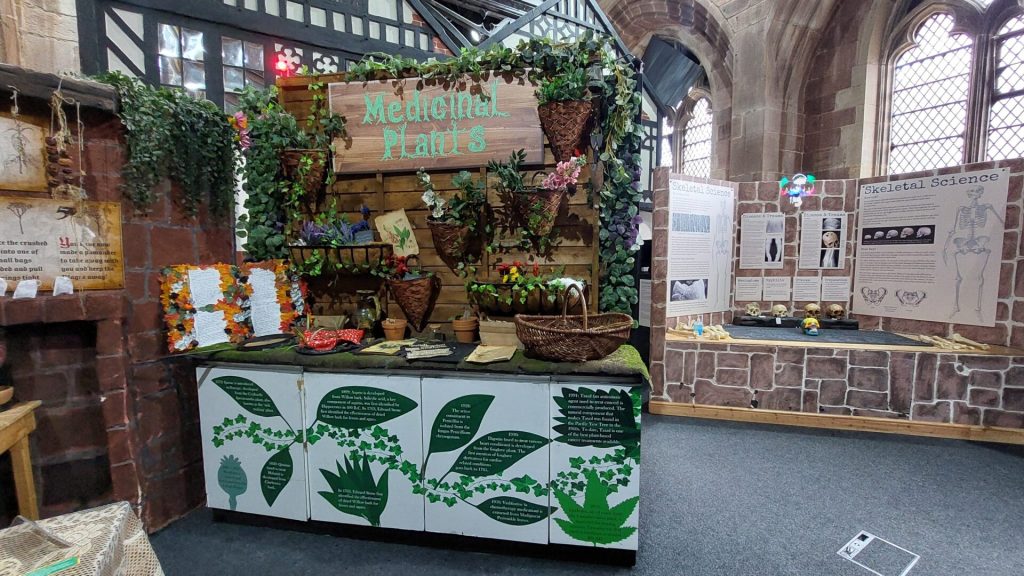
Medicinal plants, key topics: morphine, quinine, Edward Stone, penicillin, herbal remedies. 
Food, key topics: scurvy, botulism, adulteration and safety oversight, arenic, dysentry. 
Within the plant and food area there is a pomander station, which includes different types of dried flowers and herbs, along with a pestle and mortar, and small bags that can be filled to ‘make your own pomander’ to take home with you to ward of the miasmas you may encounter along the way! 
The pomander station. 
The last sections of the museum are actually located in the front of the church and again has more open space, which is useful for gathering groups together and waiting before exiting. 
Wall of Plagues: This large art installation features oversized bacteria and viruses responsible for some of the worst pandemics in history, along with figures of estimated death tolls. 
While you’re in Sick to Death, don’t forget to look up! St. Michael’s displays beautiful medieval and Victorian architecture, as well as some other little surprises. 
The curtains here lead back to the front desk and museum shop. Exit from the museum is through the same door you entered, back onto the Rows.
The museum is regularly being updated and while we will endeavour to keep this photo tour updated as well, some areas may look slightly different during your visit to how they appear here.